Wayfair raised ad spend in the year it posted its worst-ever loss
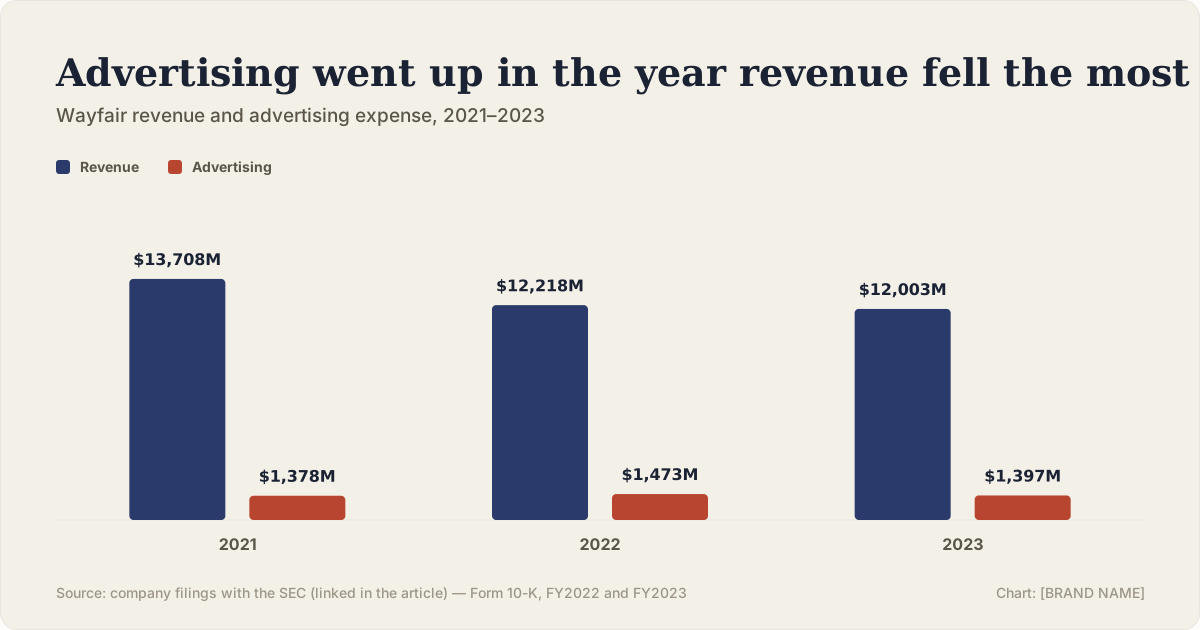
Advertising rose 6.9% in 2022 to $1.47bn. Revenue fell 10.9% the same year, and the net loss reached $1.33bn — the largest in the company's history at the time. The following year cut ad spend back, and losses narrowed, but revenue kept falling too.


One vote per reader. You can change it. No account needed.
What the filings actually show
Advertising expense and net income are both audited lines in Wayfair's 10-K, reported every year. The three years below cover the run-up to, and away from, Wayfair's largest recorded annual loss.
| Year | Revenue | Advertising | Net loss |
|---|---|---|---|
| 2021 | $13,708M | $1,378M | $131M |
| 2022 | $12,218M | $1,473M | $1,331M |
| 2023 | $12,003M | $1,397M | $738M |
2022 is the year every number moved against the company at once: revenue down 10.9%, advertising up 6.9%, and the net loss ten times larger than the year before. Advertising as a share of revenue rose from 10.1% to 12.1% in the same twelve months — spending more, on a smaller base, to defend a business that was shrinking.
The part that matters is the loss, not just the ad line
Advertising is one line among many that fed into a $1,331M net loss — cost of goods sold, fulfillment, technology and administrative costs all matter too, and this piece does not attempt to apportion the loss across them. What the filings support narrowly is the coincidence: the year advertising rose fastest is also the year revenue fell hardest and the loss reached its widest point in the window.
In 2023, Wayfair cut advertising 5.2% to $1,397M. The net loss narrowed sharply, to $738M — but revenue continued falling, down a further 1.8% to $12,003M. A smaller ad budget did not bring growth back; it accompanied a smaller loss on a still-shrinking top line.
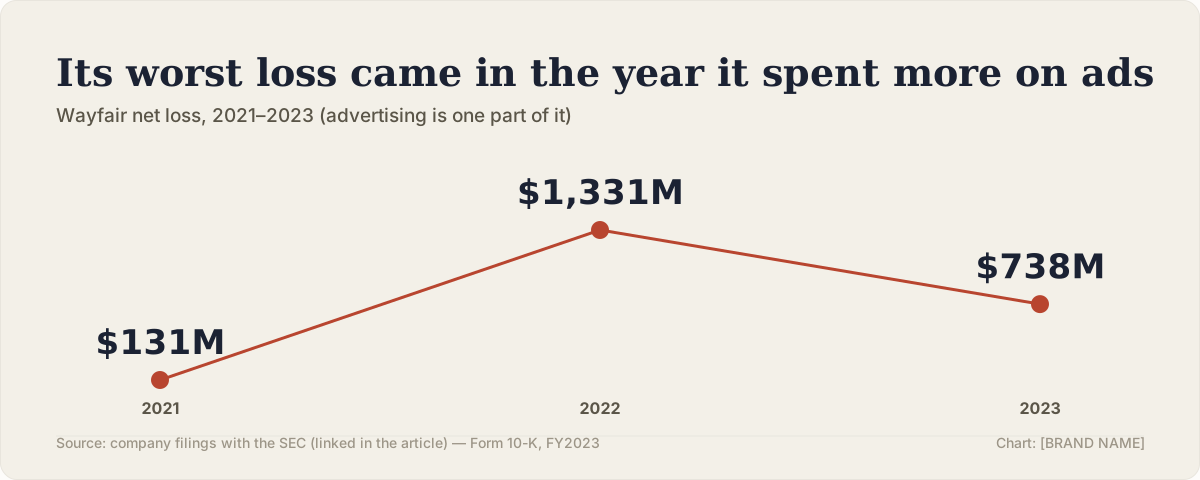
Read together, the three years do not tell a clean story in either direction. Raising spend into a downturn did not stop the loss from widening; cutting spend the following year did not stop revenue from falling further. Both decisions came with real trade-offs, and neither fixed the underlying demand problem on its own.
What a spend increase like this is really testing
Raising advertising spend while revenue is already falling is a bet that the category downturn is temporary and that maintaining share now will pay off once demand normalizes. It is a defensible strategy in principle — pulling back in a soft market can cede customers to competitors who keep advertising. The 2022 results do not validate that bet: revenue fell anyway, and the loss widened to its largest point in the company's history at the time.
That does not mean the strategy was wrong in concept. It means that, in this instance, spending more did not produce enough incremental revenue to offset the higher cost, at a moment when overall category demand was working against the company regardless of its ad budget.
What this does not prove
It does not prove that advertising spend was the wrong call, or that a smaller 2022 budget would have produced a smaller loss — a weaker ad presence in a shrinking category could plausibly have cost even more share. It also does not prove that the 2023 cut was the right one; revenue kept falling, and a larger ad budget might have slowed that decline, or might not have mattered at all.
What it does show is that neither raising nor cutting advertising spend, on its own, reversed the revenue trend across these three years. That is a narrower and less satisfying conclusion than either a clean "spend more" or "spend less" lesson, and it is the honest one the filings support.
Three things to take from it
1. A spend increase during a downturn needs its own evidence, not just intent. Defending share in a soft category is a real strategy, but "we kept spending" is not the same as "it worked" — check the revenue trend, not just the budget decision.
2. A narrower loss the following year is not the same as a fixed business. 2023's loss was less than half of 2022's, and revenue still fell. Improvement on one line does not mean the underlying trend has turned.
3. Category-wide demand shifts complicate every reading. Online furniture spending fell broadly across the industry in this period; some of Wayfair's revenue decline reflects that shift and is not something any ad budget, larger or smaller, controls.
Questions readers asked
Did raising advertising spend cause Wayfair's 2022 loss?
Advertising is one of several cost lines that fed into the $1,331M loss; the filings do not isolate its individual contribution. What they show is that advertising rose 6.9% in the same year revenue fell 10.9% and the loss reached its widest point in the window.
Did cutting advertising in 2023 fix the revenue decline?
No. Advertising fell 5.2% in 2023 and the net loss narrowed to $738M, but revenue fell a further 1.8% to $12,003M — the smaller ad budget accompanied a smaller loss, not a return to growth.
How large was the 2022 loss compared to prior years?
$1,331M, roughly ten times the $131M net loss reported for 2021, and the largest annual loss in the three years covered here.
Was the revenue decline specific to Wayfair?
Online home-goods demand slowed broadly after the pandemic-era surge, which affected the category as a whole. This piece does not attempt to separate how much of Wayfair's specific decline was category-wide versus company-specific.
This analysis is based on publicly available filings and reporting, all linked above. It represents our editorial interpretation of those sources. We have no affiliation with, and receive no payment from, any company named in this piece. If you believe a figure here is wrong, tell us — corrections are made publicly and the article is marked as updated.
Put your budget and channels into the simulator and see the range published cases landed in.