Etsy spent more on marketing than ever in 2025, and profit fell 46%
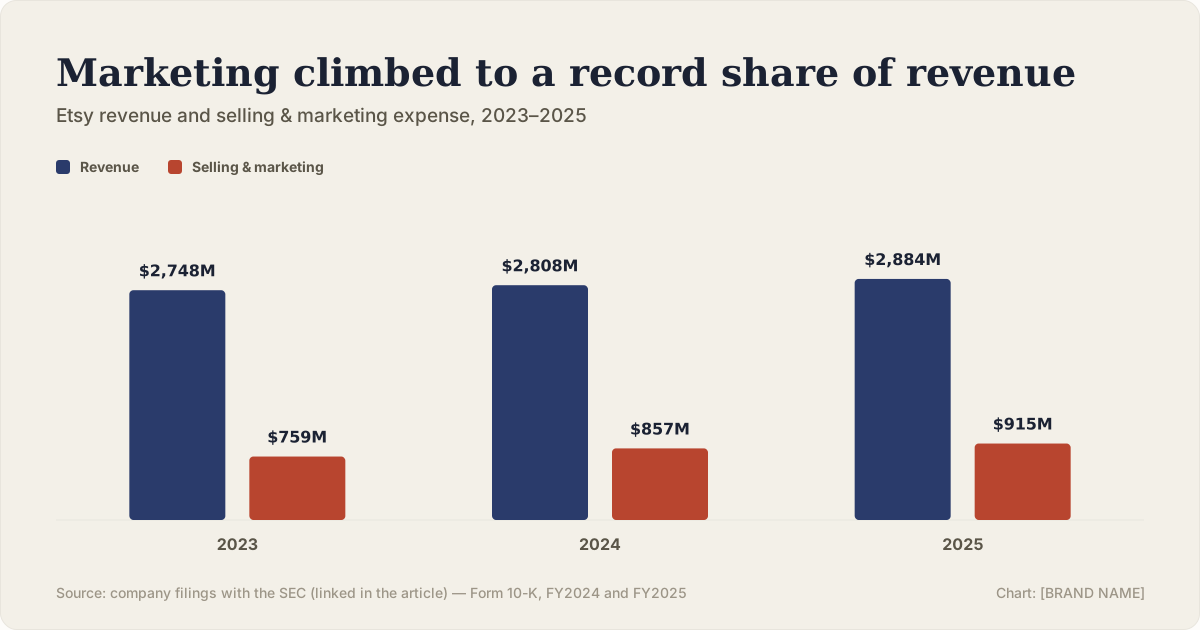
Selling and marketing climbed to 31.7% of revenue in 2025, the highest share in years. Net income fell from $303.3M to $163.0M in the same twelve months. The filings show both lines moving the wrong way at once.


One vote per reader. You can change it. No account needed.
What the filings actually show
Selling and marketing is a single audited line in Etsy's income statement, reported every year in the Form 10-K. The numbers below come from three consecutive filings, not from a single year's press release.
| Year | Revenue | Selling & marketing | Marketing as % of revenue |
|---|---|---|---|
| 2023 | $2,748.4M | $759.2M | 27.6% |
| 2024 | $2,808.3M | $856.6M | 30.5% |
| 2025 | $2,883.5M | $914.8M | 31.7% |
The ratio was flat in 2022 and 2023 — 27.7% and 27.6% of revenue — before rising four points in two years. That is not a rounding difference. It is the biggest two-year move in the ratio since Etsy's marketing spend became large enough to matter.
The part that matters is the profit line
A rising marketing ratio is not automatically bad news; it can simply mean a company is investing ahead of growth. What makes this one worth flagging is what happened to profit alongside it.
Net income was $307.6M in 2023 and $303.3M in 2024 — essentially flat. In 2025, with the marketing ratio at its highest point in the window, net income fell to $163.0M: a drop of 46.3% in a single year.
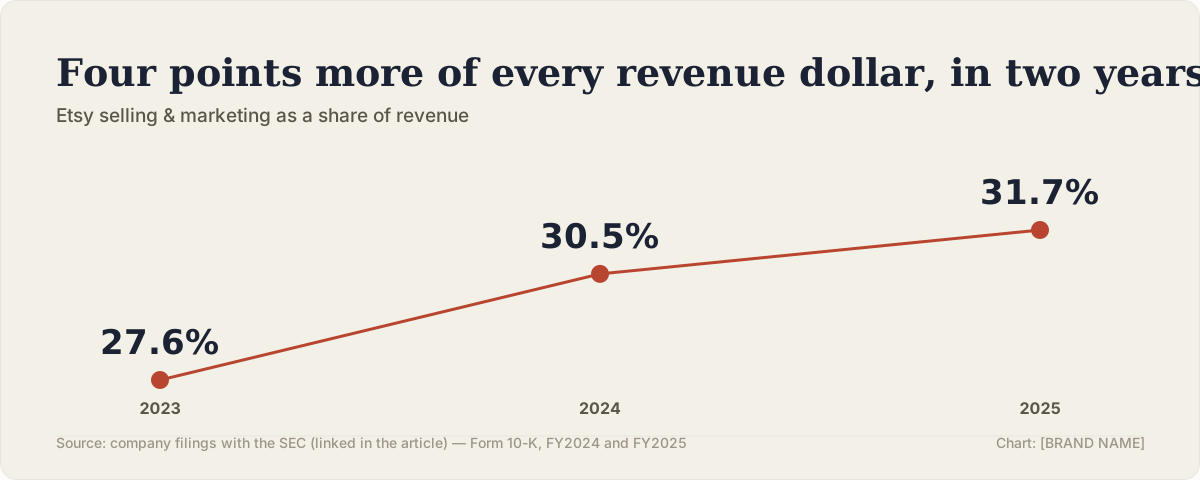
Marketing is one line among many on an income statement, and a 46% profit decline has more than one cause — cost of revenue, headcount, product mix and one-off items all move too. What the filings support narrowly is the coincidence: the year the marketing ratio hit its highest point in the window is also the year profit fell hardest.
What a rising ratio is really testing
When marketing spend grows faster than revenue for two years running, a company is testing whether the extra spend buys proportionate growth, or whether it is chasing a smaller and more expensive slice of the same buyers and sellers it already had. A rising ratio that comes with slowing revenue growth is evidence for the second explanation, not the first.
Etsy's revenue grew 2.2% in 2024 and 2.7% in 2025 — its slowest two-year stretch in the period covered here — while the marketing ratio kept climbing. Spending more to grow more slowly is the exact pattern a rising, unproductive ratio would produce.
What this does not prove
It does not prove that Etsy's marketing is badly targeted, and it does not mean the company should cut the budget. Some of the increase may be deliberate investment in newer channels or in retention programs that take longer than a year to pay back — the 10-K does not break the number down by channel, so neither can this piece.
It also does not isolate marketing as the cause of the profit decline. Cost of revenue, product development spend and other lines all moved in the same year. The honest claim is narrower: marketing rose to a record share of revenue in the same year profit fell by nearly half, and the filings do not yet show the ratio turning back down.
Three things to take from it
1. Watch the ratio, not just the budget. A marketing budget that grows in line with revenue is business as usual. One that grows faster, for two years running, is worth a second look before the profit line explains why.
2. A flat ratio year does not mean the trend has stopped. 2022 and 2023 looked stable at roughly 27.6%–27.7%. The move happened in the two years after, not gradually from the start.
3. Read the next filing before drawing a conclusion. One year of a falling ratio, or one year of profit recovering while the ratio stays high, would each tell a different story than this one does today.
Questions readers asked
Did Etsy's marketing spend cause the profit drop?
The filings do not isolate a single cause for a 46.3% net income decline. What they show is that selling and marketing expense hit its highest share of revenue in the period, 31.7%, in the same year profit fell hardest. That is a coincidence worth flagging, not a proven causal link.
How big is the marketing increase in dollars?
Selling and marketing expense rose from $759.2M in 2023 to $914.8M in 2025, an increase of $155.6M, or 20.5%, while revenue over the same two years grew 4.9%.
Was the ratio always this high?
No. The ratio was 27.7% in 2022 and 27.6% in 2023 — essentially flat — before climbing to 30.5% in 2024 and 31.7% in 2025. The move happened in the most recent two years, not gradually across the whole period.
Did net income fall every year in this window?
No. Net income was roughly flat between 2023 ($307.6M) and 2024 ($303.3M), then fell 46.3% to $163.0M in 2025 — the same year the marketing ratio reached its highest point.
This analysis is based on publicly available filings and reporting, all linked above. It represents our editorial interpretation of those sources. We have no affiliation with, and receive no payment from, any company named in this piece. If you believe a figure here is wrong, tell us — corrections are made publicly and the article is marked as updated.
Put your budget and channels into the simulator and see the range published cases landed in.