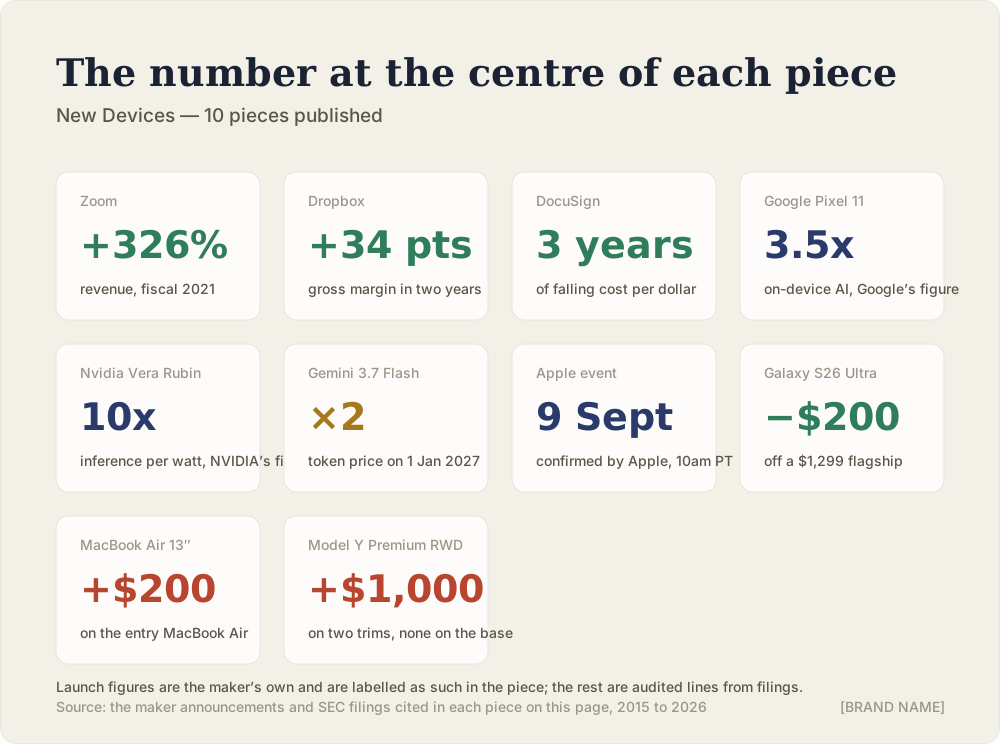
New devices, new chips, new versions — and what each one actually claims
Phones, silicon, models and the software businesses behind them. Launch figures come from the maker’s own announcement and are labelled as such; the case studies come from audited filings.
10 full pieces·3 short items·13 in total
How this category is written
A launch is a marketing document before it is anything else. So this category does two jobs at once: it pulls the numbers a maker chose to publish and says plainly that they are the maker’s and not an independent test — and then, in the longer pieces, it reads the same industry off the income statement, where the claim has already been settled.
New Devices — every piece
All 10 published in this category, filterable by format and sortable four ways
Nothing matches that combination yet. Try a wider filter.
Shorter items
Short news, with the part that matters — each one carrying its own source
Milestone
The Gemini app passed 1 billion monthly users, and 150 million images a day
Google put both figures in its own August round-up. Neither is audited and neither defines “monthly user”, so treat them as the company’s scale claim rather than a measured number — but the direction is the point: image generation is now a daily habit, not a demo.
Gemini Omni 1.1 Flash added scene extension, frame interpolation and 4K upscaling
The video model picked up three post-production jobs that used to need separate tools, and shipped them into Google Flow, AI Studio and the Gemini app at once. No pricing or quality benchmark was published alongside, which is the gap to watch.
WeatherNext 2, a cyclone-prediction model, was open-sourced and published in Nature
This is the rarer kind of technology announcement: the method went through peer review before the press release, and the weights are public. Where a launch asks you to trust the benchmark, a Nature paper lets somebody else run it.