Apple raised prices across almost the whole line, and blamed memory
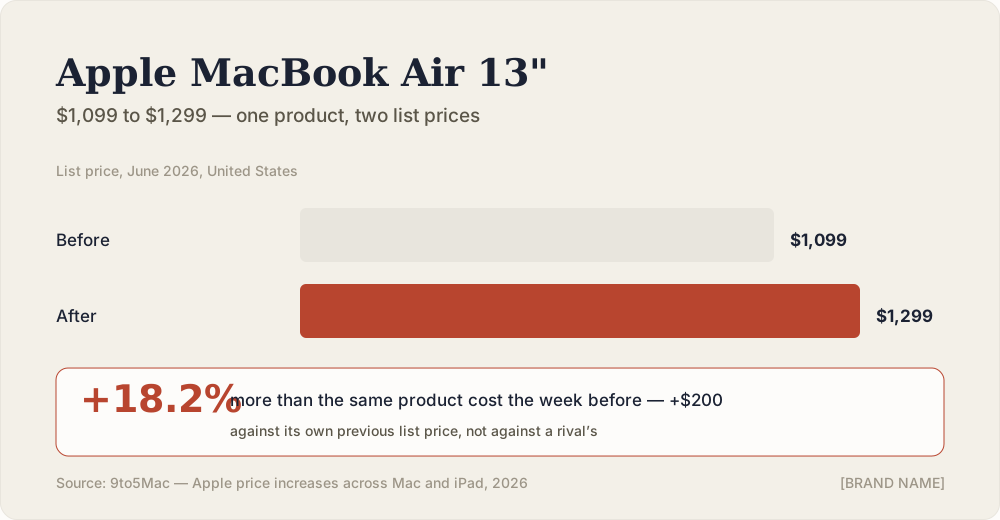
Nineteen products went up on the same day. The entry MacBook Air took $200, an 18.2% rise; the M3 Ultra Mac Studio took $1,300. Apple named a cause, which is rare enough to be worth reading carefully.

One vote per reader. You can change it. No account needed.
The whole move, in one table
Nineteen products, one day, all upward. The MacBook Air is the number that travelled, but it is not the largest rise either in dollars or in percent, and the range is the more useful thing to see.
| Product | Was | Now | Rise | Percent |
|---|---|---|---|---|
| HomePod mini | $99 | $129 | +$30 | +30.3% |
| Apple TV 4K | $129 | $199 | +$70 | +54.3% |
| iPad | $349 | $449 | +$100 | +28.7% |
| MacBook Air 13″ | $1,099 | $1,299 | +$200 | +18.2% |
| M5 MacBook Pro | $1,699 | $1,999 | +$300 | +17.7% |
| M3 Ultra Mac Studio | $3,999 | $5,299 | +$1,300 | +32.5% |
| Vision Pro | $3,499 | $3,699 | +$200 | +5.7% |
Those seven are a sample of the nineteen, chosen to show the range rather than to average it. The percentages are ours, calculated from the two prices in the source; the dollar figures are the source’s.
The cheap things went up hardest
The instinct is to read a price rise as heaviest at the top. Here it is the reverse in percentage terms. An Apple TV 4K rose 54.3% and a HomePod mini 30.3%, against 5.7% on a Vision Pro. The cheapest products in the line moved the most.
That pattern is what a component-cost shock looks like rather than what a margin grab looks like. On a $99 accessory, the bill of materials is most of the price, so a jump in one component has nowhere to hide. On a $3,499 headset the same jump is a rounding error against everything else in the cost stack. If the cause were simply “charge more because we can”, the rises would cluster where willingness to pay is highest, and they do not.
A reason, on the record
Apple gave one: component costs, with memory named specifically, and high-bandwidth memory for AI servers named as what is consuming the supply. Companies almost never explain a price rise, because the explanation is either an admission or a hostage. This one is checkable — memory contract prices are published by third parties, and anyone can see whether the shortage was real and when it eases.
It also sets up a test with a date on it. If the cause is genuinely a component shortage, prices come back down, or at least stop rising, when the shortage clears. If they do not, the reason was a floor rather than a cause. That is not a question this piece can answer today; it is a question the next couple of years answer on their own.
Why this is a marketing story too
An 18% rise on the volume laptop does something specific to a marketing budget: it raises the cost of the thing being sold without raising the number of people who want it. Every acquisition channel now has to work against a higher price point, and the usual response — spend more to keep unit volume — is precisely the decision this site has documented going wrong at Peloton and going right at Airbnb. Which one it resembles depends on whether the demand was price-sensitive, and the filings answer that a year later.
What this does not tell you
It does not tell you what Apple pays for memory, which is not public. It does not cover regions outside the United States; the source does not specify them and we have not extrapolated. And it does not tell you whether the rises stuck — a list price is what a company asks, not what it ends up taking.
Questions readers asked
How much did the MacBook Air actually go up?
The 13-inch model went from $1,099 to $1,299 — $200, or 18.2% against its own previous price. The 15-inch went from $1,299 to $1,499, the same $200 but 15.4%.
Did Apple say why?
Yes, which is unusual. It cited component costs and named memory, with Tim Cook pointing at high-bandwidth memory for AI servers absorbing supply.
Which product rose the most?
In dollars, the M3 Ultra Mac Studio: $3,999 to $5,299, a rise of $1,300. In percentage terms, the Apple TV 4K: $129 to $199, up 54.3%.
Does this apply outside the United States?
The source does not say, and we have not assumed. Every figure on this page is a US list price.
Every price above is a manufacturer list price in the United States, taken from the report linked in Sources, and it is the price on the day that report was published — not a quote, not an offer, and not what you will be charged today. We have no affiliation with, and receive no payment from, any company named here, and none of the links above is an affiliate link. If you believe a figure is wrong, tell us — corrections are made publicly and the article is marked as updated.
Every price move we track
The running list, with the source beside each number, is on Sales & Discounts.