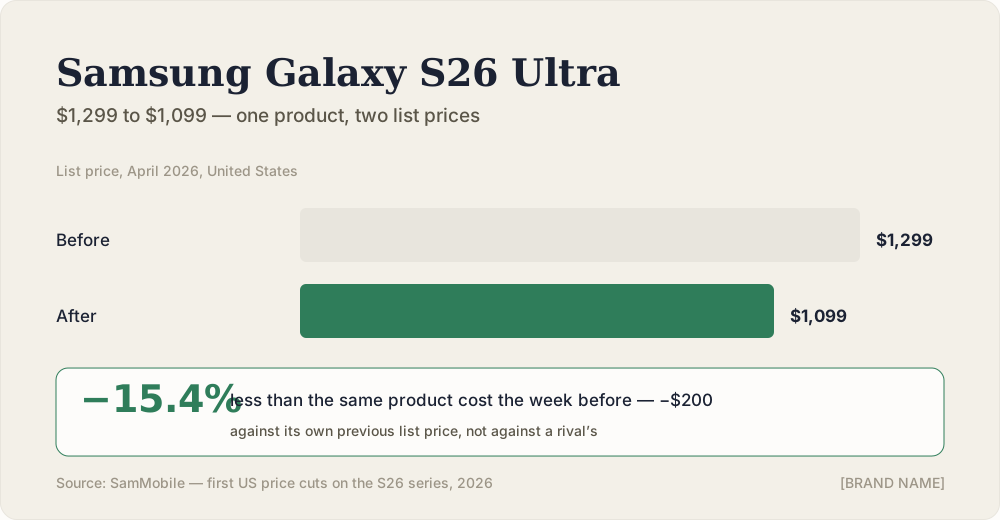
Samsung cut the Galaxy S26 Ultra by $200 — its first US price cut on the line
The Ultra went from $1,299 to $1,099 on Samsung’s own US store, without a trade-in. The S26 and S26+ came down $100 each. A flagship that discounts itself twice as hard as the phones below it is telling you something about where the demand is.


One vote per reader. You can change it. No account needed.
What was actually cut
Three phones, three different cuts, all on Samsung’s own United States store and all applied as instant credit at checkout with no trade-in required. That last condition is the whole story, and it is worth putting the numbers in a table before saying why.
| Model | Was | Now | Cut | As a percentage |
|---|---|---|---|---|
| Galaxy S26 | $899 | $799 | −$100 | −11.1% |
| Galaxy S26+ | $1,099 | $999 | −$100 | −9.1% |
| Galaxy S26 Ultra | $1,299 | $1,099 | −$200 | −15.4% |
The dollar figures for the S26 and S26+ are the reported $100 credits applied to the launch prices those models carried. The Ultra’s $200 is the figure the source states directly. We have shown the percentage for each because a flat $100 means something different on a $899 phone than on a $1,099 one, and the shape of the discount only becomes visible once you divide.
Why “no trade-in” is the important phrase
Every phone maker discounts constantly. The usual instrument is the trade-in: offer an inflated value for the handset somebody already owns, and the buyer feels a $300 saving while the manufacturer books a much smaller cost, because it gets a device it can refurbish and resell. The list price never moves, so the brand never has to admit anything.
A no-trade-in credit is the other thing. It is money off, to everybody, with nothing coming back. It shows up in the average selling price and it resets what the next buyer thinks the phone is worth. Manufacturers avoid it on flagships for exactly that reason, which is why the reporting frames this as a first for the S26 line.
The Ultra came down hardest, and that is the signal
Read the last column of the table again. The cheapest phone got 11.1% off. The middle phone got 9.1%. The most expensive got 15.4%.
That ordering is unusual. A flagship at the top of a line is normally the model with the least discounting, because the people who buy it are the least price-sensitive and because it is where the margin lives. When the top model is the one being cut hardest, the straightforward reading is that the Ultra is the model sitting in warehouses — that demand at $1,299 was thinner than the plan assumed, and $1,099 is where it clears.
That is a reading, not a disclosure. Samsung publishes no unit numbers by model and none is due. What can be said with the document in hand is narrower: the discount is largest, in both dollars and percent, on the phone with the most room in its margin to absorb it.
What this does not tell you
It does not tell you the cut is permanent. It is applied as an instant credit, and a credit can be withdrawn in a way a list price cannot; no end date was published, which cuts both ways. It does not tell you what Samsung is earning on the phone, because the bill of materials is not public. And it does not tell you anything about sales, because Samsung reports handsets inside a division that also contains networks and PCs.
What it does tell you is the number a buyer pays today, and the direction. Both are checkable, and both are on this page.
The other side of the same month
Two months after this cut, Apple went the other way across almost its entire line and put the memory shortage on the record as the reason. Same component market, same quarter, opposite decision. Whichever of the two turns out to have read demand correctly, the filings will show it long before either company says so.
Questions readers asked
Is this a permanent price cut or a promotion?
It is applied as an instant credit at checkout on Samsung’s US store rather than as a change to the published list price, and no end date was given. Practically it is what you pay today; formally it is reversible in a way a list-price change is not.
Does the cut depend on trading in an old phone?
No. That is the unusual part. The reporting is explicit that these are no-trade-in prices, valid across every colour and every storage option.
Why is the Ultra’s cut bigger than the other two?
Samsung has not said. What the numbers show is that the most expensive model is being discounted hardest in both dollars and percent, which is the reverse of the usual pattern for a flagship.
Where does this leave the price against last year’s model?
That comparison is not in the source and we have not made it. Every percentage here is against the S26’s own launch price in the same market.
Every price above is a manufacturer list price in the United States, taken from the report linked in Sources, and it is the price on the day that report was published — not a quote, not an offer, and not what you will be charged today. We have no affiliation with, and receive no payment from, any company named here, and none of the links above is an affiliate link. If you believe a figure is wrong, tell us — corrections are made publicly and the article is marked as updated.
Every price move we track
The running list, with the source beside each number, is on Sales & Discounts.