Nvidia shipped Vera Rubin, and the claim to check is 10x per watt
Seven chips, three rack configurations, and a set of headline numbers that are almost all ratios rather than totals. For anyone buying compute rather than reading about it, the denominator is the part that decides what the platform costs to run.


One vote per reader. You can change it. No account needed.
What shipped, and when
Nvidia described the Vera Rubin platform in a release dated 16 March 2026, and followed it on 31 May 2026 with a second saying the platform had ramped into full production, with production shipments beginning in the autumn. The named early adopters in that second release are cloud and neocloud operators: CoreWeave, Lambda, Oracle Cloud Infrastructure, Microsoft Azure, IBM Cloud, Nebius, Nscale, Firmus, GMI Cloud, IREN, SpaceXAI and Vultr.
That list is worth reading as a business fact rather than a technical one. The buyers named are companies whose product is rented compute. They are the customers most exposed to the cost of running a rack for three years, which is exactly the thing the platform’s headline numbers are pitched at.
Seven chips, three racks
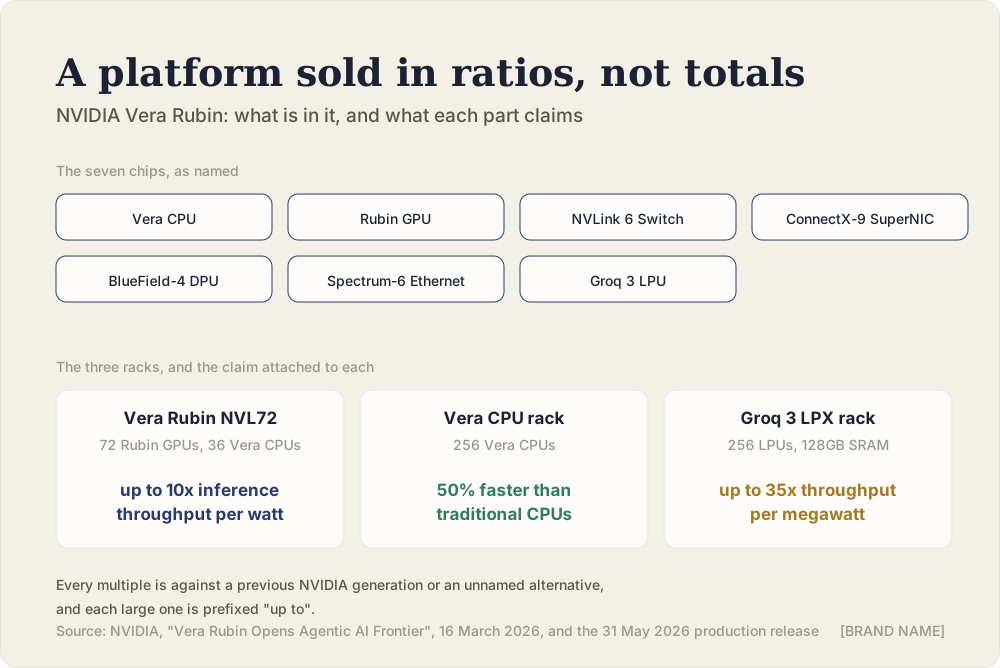
The platform is described as seven chips designed to work as one machine: the Vera CPU, the Rubin GPU, an NVLink 6 Switch, a ConnectX-9 SuperNIC, a BlueField-4 DPU, a Spectrum-6 Ethernet switch and a Groq 3 LPU. Three rack configurations are built from them, and each carries its own claim.
| Rack | What is in it | The claim, as published |
|---|---|---|
| Vera Rubin NVL72 | 72 Rubin GPUs, 36 Vera CPUs | “up to 10x higher inference throughput per watt at one-tenth the cost per token” |
| Vera CPU rack | 256 Vera CPUs | “twice as efficiently and 50% faster than traditional CPUs” |
| Groq 3 LPX rack | 256 LPUs, 128GB on-chip SRAM | “up to 35x higher inference throughput per megawatt”, 640 TB/s scale-up bandwidth |
Two further figures sit alongside: the NVL72 is said to train large mixture-of-experts models with one-fourth the number of GPUs compared with the Blackwell platform, and the whole DSX arrangement is said to allow 30% more AI infrastructure inside a fixed-power data centre.
Why every number is a ratio
Notice what almost none of these claims are: totals. Not “this many operations per second”, but per watt, per megawatt, per token, per fixed-power building. A vendor picks the denominator that flatters the product, and it also picks the one its customers are complaining about.
For most of computing’s history the numerator was the interesting half — more speed, at whatever power it took. A platform launched almost entirely in per-watt terms is telling you that the buyers it is aimed at cannot get more power into the building, so the only way to sell them more compute is to make each watt do more. “30% more AI infrastructure within a fixed-power data center” states that assumption outright: the power envelope is treated as fixed, and the engineering goal is what fits inside it.
The same logic explains the one non-performance number in the set. “One-tenth the cost per token” is not a hardware specification at all. It is a unit-economics claim, and tokens are the unit these customers bill their own customers in.
The one figure a buyer can act on
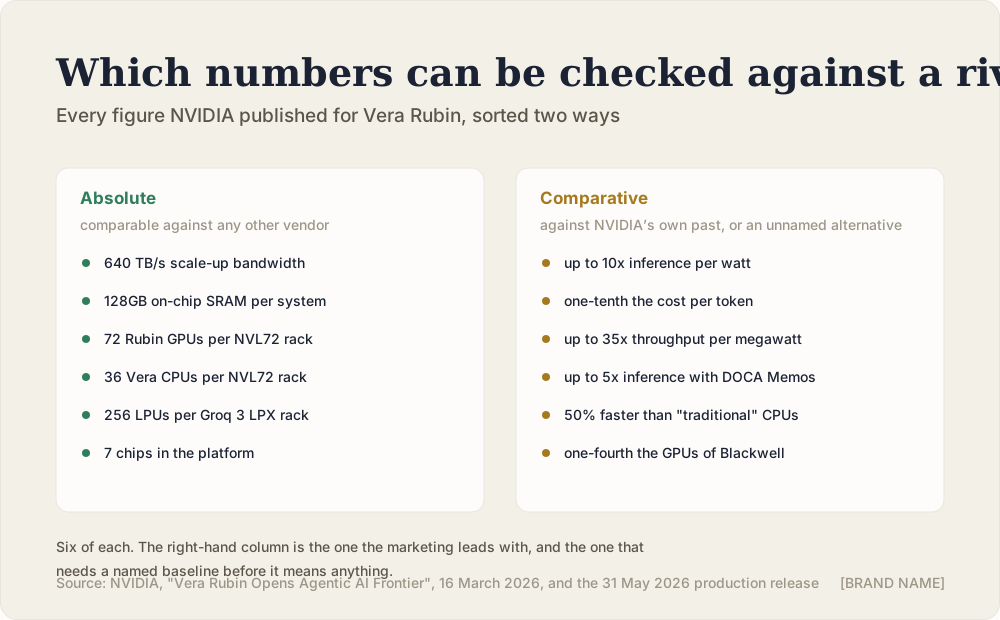
If you strip out everything comparative, one number survives with a unit attached to it: 640 TB/s scale-up bandwidth on the Groq 3 LPX rack, alongside 128GB of on-chip SRAM per system. Those are absolute, and a competing vendor’s figure can be put next to them.
Everything else — 10x, 35x, 5x, 50%, one-quarter, one-tenth — is a comparison against a previous Nvidia generation or against an unnamed “traditional” alternative, published by Nvidia, and every one of the large multiples is prefixed “up to”. That does not make them false. It makes them the ceiling of a range whose floor was not published.
What this does not tell you
It does not tell you what a rack costs, because no price was published. It does not tell you what any of this delivers on your workload, because the benchmark workloads behind the multiples are not specified in the releases cited here. And it does not tell you how much of the claimed gain is the chips versus the interconnect versus the software stack, which matters a great deal if you were considering buying only part of the platform.
What it does establish is the direction of the industry’s constraint. When the most valuable company in the sector launches its flagship in per-watt and per-token terms, the scarce input is no longer transistors. It is electricity, and the floor space to spend it in.
Questions readers asked
Are these independent benchmarks?
No. Every figure above is Nvidia’s own, taken from the two press releases linked in Sources. They are Tier 1 in that the company is formally on the record, but they are not third-party test results and this piece does not present them as such.
What does “cost per token” actually mean here?
A token is the unit AI services are metered in. “One-tenth the cost per token” is therefore a claim about the operating economics of running a model, not about the speed of a chip — which is why it is the figure a cloud operator would care about most.
Why does a Groq chip appear in an Nvidia platform?
Nvidia lists “NVIDIA Groq 3 LPU” as one of the seven chips in the platform, and describes a rack of 256 of them. The releases cited here do not set out the commercial arrangement behind that naming, so neither does this piece.
When can anyone actually buy it?
Nvidia said on 31 May 2026 that production shipments would begin in the autumn of 2026, through the cloud and neocloud partners named in that release. No list price was published.
Every performance figure above is the manufacturer’s own, published in the releases linked in Sources, and is labelled as such throughout. No independent testing was carried out for this piece and none is implied. We have no affiliation with, and receive no payment from, any company named here. If you believe a figure is wrong, tell us — corrections are made publicly and the article is marked as updated.