Gemini 3.7 Flash launched at half price, and the price doubles in January
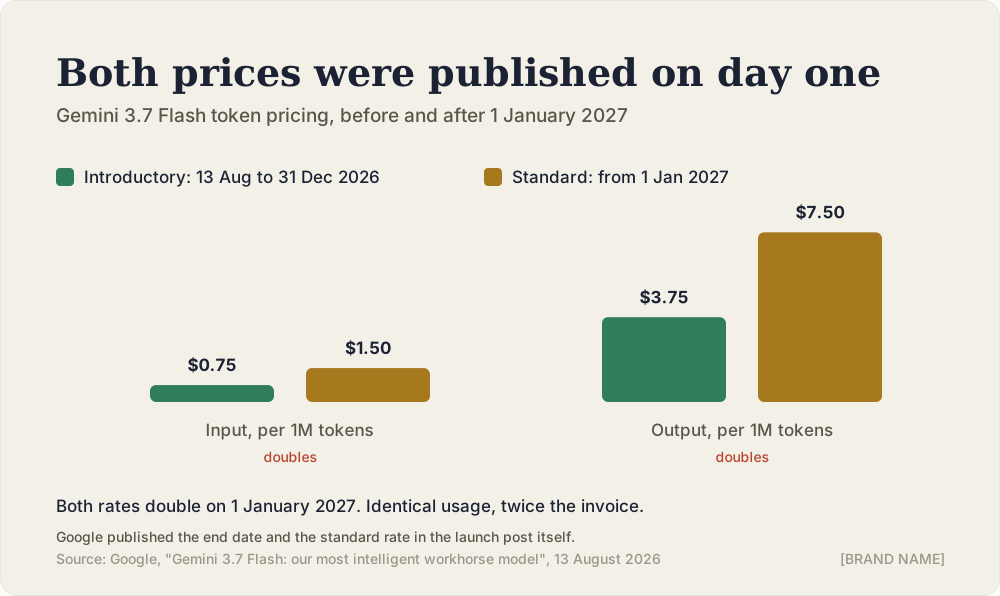
A model release on 13 August 2026 with better benchmarks than the version three weeks before it, at half the cost per million tokens. The doubling on 1 January 2027 is in the same announcement, in the same paragraph, and it is the number that will matter to anyone building on it.

One vote per reader. You can change it. No account needed.
The two prices
Both halves were published together, which is more disclosure than an introductory offer usually carries.
| Period | Input, per 1M tokens | Output, per 1M tokens |
|---|---|---|
| 13 Aug – 31 Dec 2026 | $0.75 | $3.75 |
| From 1 Jan 2027 | $1.50 | $7.50 |
| Change | +100% | +100% |
The introductory rate is described as half the per-million-token cost of Gemini 3.6 Flash. Read the two rows together and the actual position is narrower than “half price”: for four and a half months the model costs half of its predecessor, and after that it costs the same as its predecessor did — while being, on Google’s own benchmarks, a better model. That is still a real improvement in value. It is just not a price cut.
What actually improved
Google published five benchmark comparisons against 3.6 Flash, and all five move in the same direction.
| Benchmark | 3.6 Flash | 3.7 Flash |
|---|---|---|
| FrontierCode 1.1 Main | 34.4% | 43.6% |
| DeepSWE v1.1 | 49.0% | 65.3% |
| WebDev Arena (Elo) | 1538 | 1588 |
| GDP.pdf | 22.0% | 34.0% |
| AutomationBench | 17.0% | 30.4% |
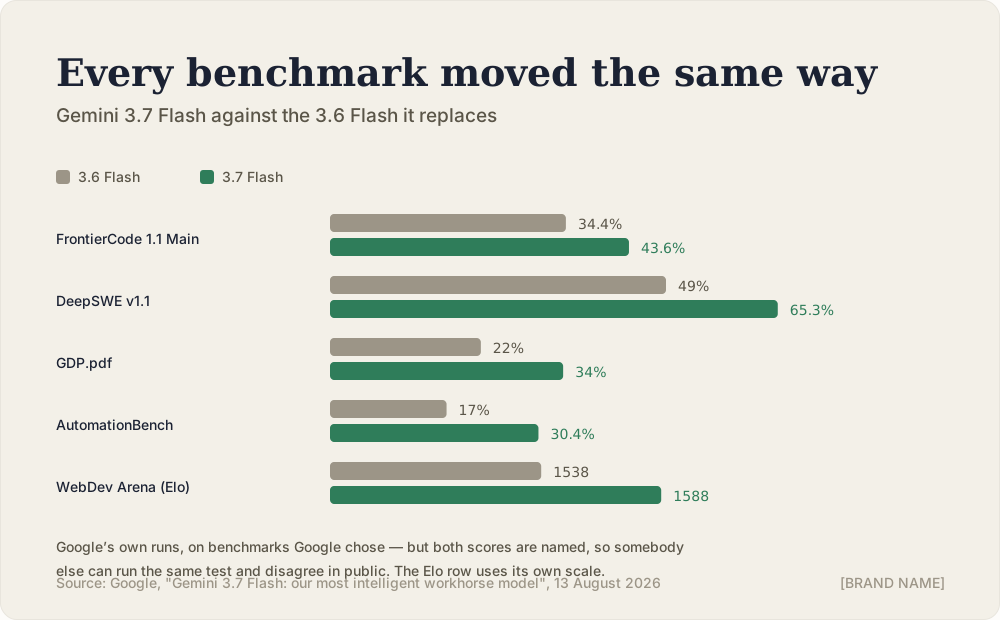
The largest relative moves are on the agentic and automation benchmarks — AutomationBench nearly doubles, DeepSWE rises by a third — which matches how the model is positioned, as a workhorse for coding and agents rather than for chat. The model is available through Google Antigravity, the Gemini API via AI Studio and Android Studio, the Gemini Enterprise products, and to Pro and Ultra subscribers in the Gemini app.
These are the vendor’s own runs on benchmarks the vendor selected. Unlike a phone’s “up to 3.5x faster”, though, they are named benchmarks with published scores on both sides, which means somebody else can run the same test and disagree in public. That is a meaningfully higher standard of claim.
Three weeks between versions
Google’s own August round-up notes that 3.7 Flash arrived three weeks after 3.6 Flash. For anyone costing a product, the release cadence is as consequential as the price: a model you integrated in July was superseded before the quarter ended.
That cuts both ways. It means capability per dollar is improving fast enough that a rebuild may pay for itself within months. It also means any figure you quote to a client about model quality has a shelf life measured in weeks, and any procurement process longer than a quarter will conclude against a model that no longer represents the frontier.
The planning problem
Here is the practical consequence, and it is the reason this launch is filed here rather than passed over as a routine version bump.
Suppose a product spends 50 million input and 10 million output tokens a month. At the introductory rate that is $37.50 plus $37.50, or $75 a month. From 1 January the identical usage costs $150 a month. Nothing about the product changed; the line item doubled on a date that was public from day one.
At small volumes that is noise. At a hundred times the volume it is $7,500 a month appearing in a January budget that was modelled in August, and the only defence is having read the second half of the pricing paragraph. Introductory pricing is not a trick — Google published the end date and the standard rate together — but it does quietly transfer the work of noticing onto the buyer.
What this does not tell you
It does not tell you how 3.7 Flash compares with anything from another vendor, because every comparison published is against its own predecessor. It does not give a context window, a rate limit or an availability guarantee. And it does not tell you whether the 1 January price will hold: a published future price is a stated intention, not a contract, and the same cadence that produced 3.7 Flash three weeks after 3.6 can produce a 3.8 with its own introductory rate before January arrives.
What it does give you is two dated, unambiguous prices in a market where most vendors publish one. Use both.
Questions readers asked
Is this a price cut or a price rise?
Both, in sequence. Against Gemini 3.6 Flash it is a cut of half for the rest of 2026. Against itself it is a doubling on 1 January 2027, back to roughly what 3.6 Flash cost — for a model that scores better on every published benchmark.
Are the benchmark scores independent?
No. They are Google’s own runs, on benchmarks Google selected, published in the launch post. They are stronger than a typical vendor claim because the benchmarks are named and both scores are given, so a third party can reproduce and contest them.
What happens to my costs on 1 January 2027?
On the published rates, identical usage costs exactly twice as much: input goes from $0.75 to $1.50 per million tokens and output from $3.75 to $7.50. A workload costing $75 a month becomes $150 a month with no change to the product.
How does it compare to models from other vendors?
The announcement does not say, and neither does this piece. Every published comparison is against Gemini 3.6 Flash. A cross-vendor comparison needs benchmarks run by someone with no product in the race.
Prices and benchmark scores above are the vendor’s own, published in the announcement linked in Sources, and are labelled as such throughout. The worked cost example is arithmetic on those published rates, not a quote or a forecast. We have no affiliation with, and receive no payment from, any company named here. If you believe a figure is wrong, tell us — corrections are made publicly and the article is marked as updated.