Google’s Pixel 11 pitch is one chip claim: on-device AI 3.5x faster
Three phones at $899, $1,099 and $1,299, announced on 12 August 2026 and on shelves on the 20th. A dozen numbers came with them. Almost all are percentages measured against Google’s own previous phone, and that is the thing worth understanding before you read any of them.

One vote per reader. You can change it. No account needed.
What was actually announced
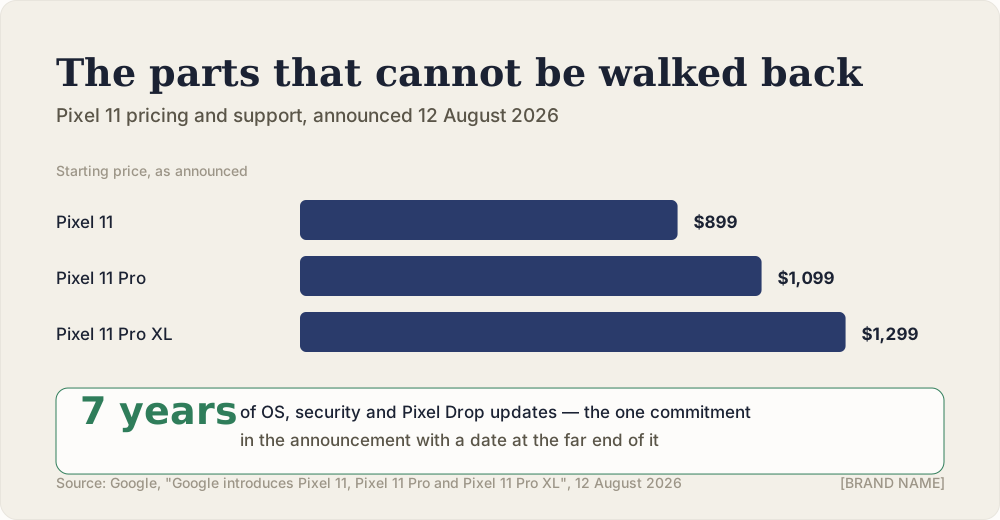
Three phones, one chip, and a support promise. The prices and the dates are the parts of a launch that cannot be walked back, so they go first.
| Model | Starting price | Pre-order | On sale |
|---|---|---|---|
| Pixel 11 | $899 | 12 Aug 2026 | 20 Aug 2026 |
| Pixel 11 Pro | $1,099 | 12 Aug 2026 | 20 Aug 2026 |
| Pixel 11 Pro XL | $1,299 | 12 Aug 2026 | 20 Aug 2026 |
All three carry seven years of OS, security and Pixel Drop updates. That is the one commitment in the announcement with a date attached to the far end of it, and it is the one a buyer can still hold the company to in 2033. On a $899 phone it is also, quietly, the largest number in the release: seven years of support is most of what separates a phone bought once from a phone bought twice.
The chip claim, unpacked
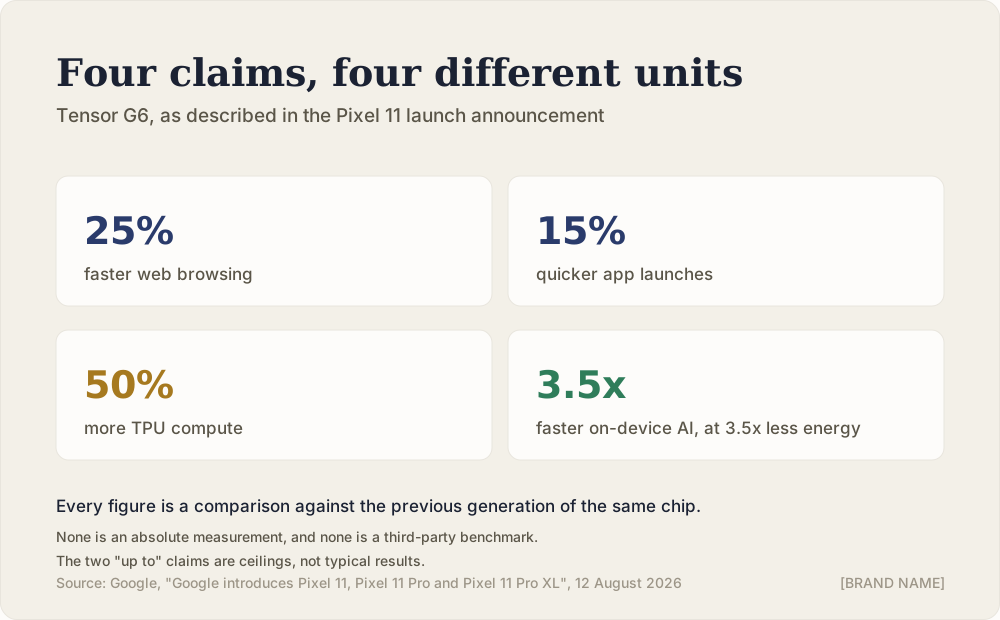
Tensor G6 is the centre of the pitch, and Google published four numbers for it: 25% faster web browsing, 15% quicker app launches, 50% more TPU compute, and on-device AI tasks running “up to 3.5 times faster while using up to 3.5 times less energy”.
Read the grammar of those four, because it differs. The first two are stated flatly. The third describes the silicon rather than the experience — more compute available is not the same as anything being faster. The fourth, the one that leads the marketing, carries “up to” twice in a single sentence.
“Up to” is not a weasel word for its own sake. On a phone an AI workload genuinely does vary by task, by thermal headroom and by how much of the job the TPU can take. But it means the figure describes a best case that Google measured, on tasks Google chose, against a baseline the announcement does not name. The honest reading is: the ceiling moved, and it moved a long way. Where the floor sits is not in the document.
The camera numbers do the same thing
The camera list is longer and built the same way. Pixel 11 gets a larger 48-megapixel main sensor with 56% more light sensitivity, and its 5x telephoto now reaches 30x Super Zoom. The Pro models get a new main sensor and an upgraded 48-megapixel telephoto with 30% more light sensitivity, Pro Zoom to 120x, portrait mode at 5x, and Night Sight capturing “up to 4 and a half times faster”.
Megapixels and zoom multiples are specifications: they are what they are, and two phones can be compared on them. “56% more light sensitivity” and “4 and a half times faster” are comparisons, and a comparison needs a named baseline before it means anything. The announcement supplies the direction and the size of the move, not the starting point.
Three hardware claims sit outside that pattern and are worth more than the percentages. The camera bar is 40% thinner, which is a physical dimension anybody can check by holding one. The Pro display coating has “more than double the scratch resistance” of the previous generation, which is the sort of claim a consumer-protection regulator can test. And the Pro display reaches 3,600 nits — an absolute figure, and therefore comparable against anyone else’s.
The one number stated in useful units
The Pixel 11 Pro XL charging claim is “15 hours of battery life in 15 minutes” on a wired charger, with Qi 2.2 wireless at 25W. That is the most useful sentence in the whole announcement, because it is expressed in the units a buyer actually experiences — minutes plugged in, hours of use — rather than as a percentage improvement over a phone they no longer own.
It is still a manufacturer figure measured under manufacturer conditions. But it is falsifiable in a way that “50% more TPU compute” is not, and the gap between those two kinds of claim is most of what separates a specification from a slogan.
What this does not tell you
It does not tell you the Pixel 11 is faster than any competing phone, because every figure here compares it to the phone Google sold last year. It does not tell you whether the AI speed-up is noticeable in the applications you use, because the tasks behind “3.5 times faster” are not listed. And it tells you nothing about sales: no unit numbers, no pre-order figures, and none are due, because Alphabet does not break Pixel out as a segment in its filings.
What it does tell you is the price of admission, the date, and the length of the support commitment. Those three are firm. Everything else in the announcement is a claim awaiting an independent test, and repeating the percentages without that sentence attached would be doing the launch’s marketing rather than reporting it.
Questions readers asked
Are these figures independent benchmarks?
No. Every performance and camera figure in this piece comes from Google’s own launch announcement of 12 August 2026, and describes Google’s measurement against Google’s previous generation. They are Tier 1 in the sense that the company is on the record saying them. They are not third-party test results, and we have not treated them as such.
Was the Pixel 11 Pro Fold part of the same announcement?
It was shown at the same Made by Google 2026 event but in a separate post, and its pricing and specifications are not covered here. This piece is limited to the three devices in the announcement it cites.
What does “50% more TPU compute” mean for me?
On its own, nothing you can feel. It describes capacity on the chip, not the speed of any task you run. The user-facing version of that claim is the separate “up to 3.5 times faster” figure for on-device AI, which carries its own caveat.
Which numbers here are safe to quote?
The prices ($899 / $1,099 / $1,299), the dates (12 and 20 August 2026), the seven-year update commitment, the 3,600-nit display and the 40% thinner camera bar. Those are absolute or physical. The percentage improvements are comparisons whose baseline the announcement does not state.
Every performance figure above is the manufacturer’s own, published in the announcement linked in Sources, and is labelled as such throughout. No independent testing was carried out for this piece and none is implied. We have no affiliation with, and receive no payment from, any company named here. If you believe a figure is wrong, tell us — corrections are made publicly and the article is marked as updated.