Apple’s next iPhone event is 9 September — what is confirmed, and what is not
Apple has published exactly one thing about tomorrow: a date, a time, a place and three words. Everything else you have read about the iPhone 18 Pro and a folding iPhone is somebody’s reporting of an unannounced product. Both are worth knowing. They are not the same kind of fact, and this piece keeps them apart.

One vote per reader. You can change it. No account needed.
What Apple has actually said
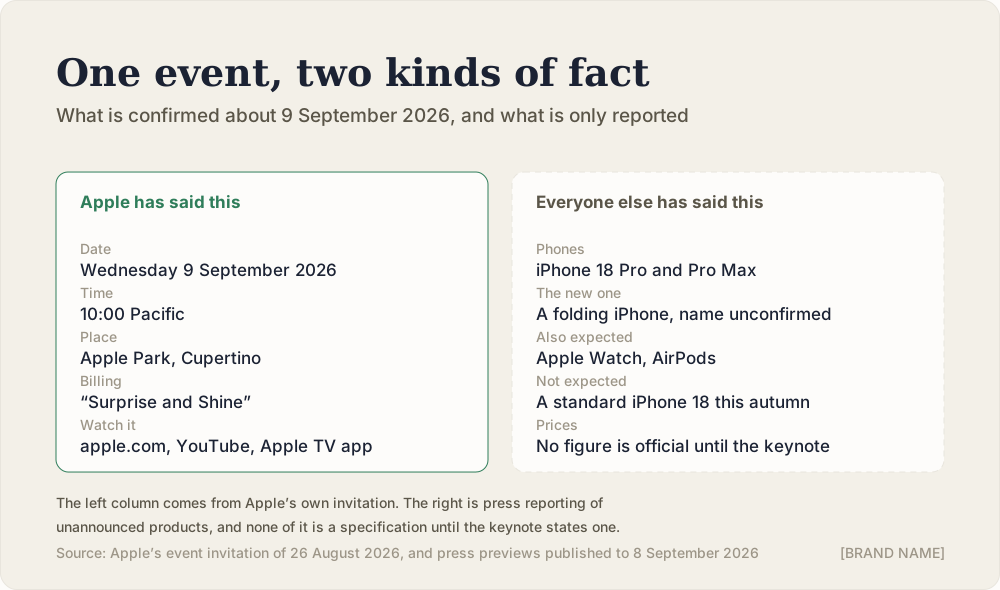
On 26 August 2026 Apple sent invitations to press and posted the billing publicly. The whole of the confirmed information fits in a table, which is worth doing precisely because it is so much shorter than the coverage around it.
| What | Confirmed detail |
|---|---|
| Date | Wednesday 9 September 2026 |
| Start | 10:00 Pacific (18:00 UK, 19:00 CET) |
| Venue | Apple Park, Cupertino, California |
| Billing | “Surprise and Shine” |
| How to watch | apple.com, YouTube, the Apple TV app |
That is it. No product name, no price, no ship date, and nothing about what “Surprise and Shine” refers to. Apple’s taglines are written to be readable both ways — they mean something after the keynote and nothing before it — and reading a product roadmap out of three words is a game, not analysis.
What is expected, and how firmly
The consensus preview, assembled from supply-chain reporting rather than from Apple, is a three-part line-up: an iPhone 18 Pro and iPhone 18 Pro Max, and a folding iPhone whose name is not settled — “iPhone Ultra” is the label most reporting has settled on, and Apple has never used it.
The detail behind those names varies enormously in how well supported it is. Reporting describes the folding model as a book-style device with a roughly 5.5-inch outer screen and a 7.8-inch inner one, a side-button Touch ID rather than Face ID, and two rear cameras instead of three. For the Pro phones it describes a variable-aperture main camera, a smaller Dynamic Island and a new 2-nanometre chip. Watches and AirPods are expected alongside, and a home display device has been reported as possible.
None of that is a specification. It is a well-informed forecast, and the useful way to hold it is as a probability rather than a fact: the shape of the line-up in these previews is usually right, and the individual numbers are frequently wrong by the time the keynote runs.
One piece of reporting matters more than the hardware detail, and it is the one worth carrying into a planning meeting: there is reportedly no standard iPhone 18 this autumn. The cheaper models are said to be held back to spring 2027, splitting what has been a single September launch into two events a year. If that is right, it changes the shape of the fourth quarter for everyone who sells accessories, trade-ins, contracts or anything else priced off a new iPhone.
The one number that is not a rumour
There is exactly one figure in this whole story that comes with a date and a source: 10:00 Pacific on 9 September. Everything else — the $2,000 starting price attached to the folding phone in reporting, the $100 to $300 rise attached to the Pro models, the milliamp-hour battery figures, the screen sizes to one decimal place — is a number somebody heard.
That is not a reason to ignore them. Supply-chain reporting has a real track record and the price direction it is describing is consistent across outlets. It is a reason to write them down with the word “reportedly” still attached, because the cost of forgetting which figures were confirmed is that a forecast built on them looks exactly like a forecast built on filings.
This is the same rule the rest of this site runs on, pointed at a launch instead of at an income statement: the announcement is the claim, and the evidence arrives later. Tomorrow the claims become official; the evidence about whether anybody bought them arrives in a quarterly filing months after that.
Why a folding phone is a pricing story
If the folding iPhone lands near the price reporting suggests, it opens a tier above the Pro Max rather than replacing anything. That is the interesting business question, and it is one the filings will eventually answer: Apple does not break out iPhone by model, but it does report iPhone revenue and it does report average selling prices indirectly through segment revenue against unit commentary.
A new top tier does one of two things. It lifts the average selling price, which shows up as iPhone revenue growing faster than unit volume. Or it cannibalises the Pro Max, which shows up as revenue flat while the mix moves. Those two look identical in a launch-day headline and completely different two quarters later, which is when this piece is worth revisiting.
The comparison worth holding in mind is the one this site has already documented in another category: a launch price and the price six months later are different products commercially, even when the hardware is identical.
What to watch for during the keynote
Five things turn from reporting into fact between 10:00 and about 11:30 Pacific, and they are the ones to write down:
| Watch for | Why it matters |
|---|---|
| The starting price of each model | The only figure that settles whether this is a price rise or a mix change |
| Whether a standard iPhone 18 appears at all | Confirms or kills the two-launches-a-year theory, which reshapes Q4 retail |
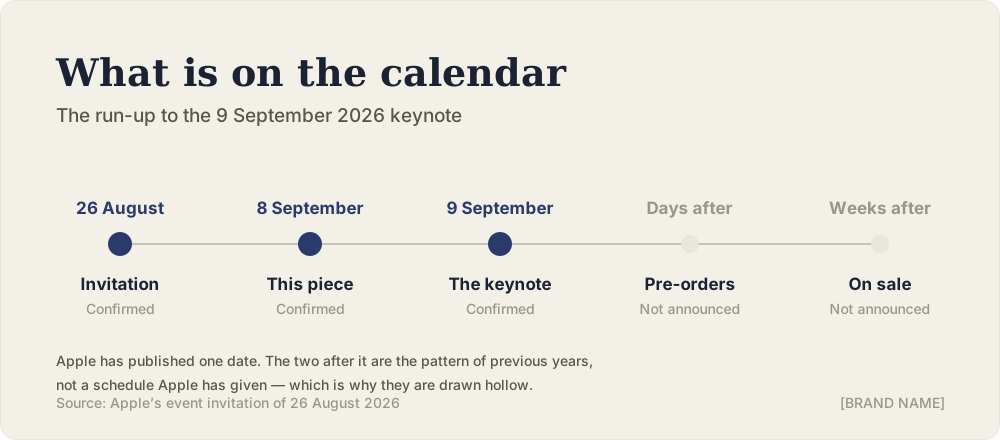
| Pre-order and on-sale dates | Determines which quarter the revenue lands in |
| Which figures are given as absolutes | Nits, hours, prices are checkable; “up to” percentages are not |
| Whether the folding phone ships this year | An announced product with no date is a roadmap, not a launch |
We will update this piece after the keynote with what was actually announced, marked as an update, and the reporting above will stay visible rather than being quietly corrected. Whether a preview was right is part of what tells you how much to trust the next one.
Questions readers asked
When exactly is the event where I am?
10:00 Pacific on Wednesday 9 September 2026, which is 13:00 US Eastern, 18:00 in the UK, 19:00 in central Europe and 21:00 in Georgia. Apple streams it on apple.com, on YouTube and through the Apple TV app, so no ticket or account is needed.
Is the iPhone 18 launching at this event?
Reporting says no — that the Pro models come in September and the standard iPhone 18 is held back to spring 2027. Apple has not confirmed this, and it is the single reported detail with the largest commercial consequences, so treat it as the thing to check first during the keynote rather than as settled.
How much will the folding iPhone cost?
Nobody outside Apple knows. Reporting has converged on a starting price around $2,000, but no price exists in any Apple document and we are not going to print one as though it does. The price becomes a fact during the keynote and not before.
Why publish a preview at all if most of it is unconfirmed?
Because the date is real and people plan around it, and because the line between the confirmed part and the reported part is exactly the thing most coverage blurs. Knowing which half of a preview is which is more useful than the preview.
Everything in this piece is either a detail Apple has published itself, marked as confirmed, or press reporting of products Apple has not announced, marked as reported. No price, specification or ship date here is official. We have no affiliation with, and receive no payment from, any company named. If you believe something here is wrong, tell us — corrections are made publicly and the article is marked as updated.